

Software is no longer something people buy in a box. Today, people open a browser, log in, and use powerful tools from any device. This model is called Software as a Service, or SaaS. It has changed how companies sell, how customers buy, and how teams work.
If you have an idea for a software product, or you want to move your current tool to the cloud, you need to understand SaaS development. This guide explains everything in simple words. You will learn what SaaS development is, how the process works, what technology to use, how much it costs, and how to avoid common mistakes.
Let’s start with the basics.
What Is SaaS Development?
SaaS development is the process of planning, designing, building, testing, and launching software that runs in the cloud. Users do not install anything. They sign in through a web browser or an app and pay a monthly or yearly fee to use it.
Think about tools you may already use, such as project management apps, online accounting software, customer relationship systems, or video meeting platforms. All of these are SaaS products.
A SaaS product is different from traditional software in a few key ways:
- It lives in the cloud. The company hosts it on cloud servers, and users reach it over the internet.
- It uses a subscription model. Customers pay on a recurring basis instead of a single large payment.
- It updates automatically. The provider releases new features and fixes, and every user gets them at once.
- It serves many customers at the same time. One system supports thousands of users while keeping their data separate.
Good SaaS development focuses on more than writing code. It combines product strategy, user experience, cloud engineering, security, and long-term support.
Why SaaS Is Growing So Fast in the United States
The US is one of the largest SaaS markets in the world. American businesses of all sizes, from small startups to big enterprises, now rely on cloud software every day. There are several reasons for this growth.
Lower upfront costs. Businesses do not need to buy expensive servers or licenses. They pay a smaller fee each month and scale up when needed.
Remote and hybrid work. Teams spread across different cities and states need tools they can reach from anywhere. SaaS fits this need perfectly.
Faster setup. A customer can sign up and start using a SaaS tool in minutes. Traditional software may take weeks to install and configure.
Predictable revenue for founders. Subscription income is steady. This makes it easier to plan, hire, and grow, and it is attractive to investors.
Easy scaling. Cloud platforms let a SaaS company handle ten users or ten million users without rebuilding everything from scratch.
Because of these benefits, more founders and companies are investing in SaaS development every year.
Core Features Every SaaS Product Needs
Not every SaaS product is the same, but most successful ones share a set of core features. When you plan your product, make sure these are part of the foundation.
User Authentication and Access Control
Users must be able to sign up, log in, and reset passwords safely. Many products also offer single sign-on, two-factor authentication, and role-based permissions so that admins, managers, and regular users see only what they should.
Subscription and Billing Management
Your product needs a reliable way to collect payments. This includes free trials, plan upgrades and downgrades, invoices, refunds, and failed payment handling.
Multi-Tenant Architecture
Multi-tenancy means many customers share the same software and infrastructure, while their data stays private and separate. This is the most common and cost-effective SaaS design.
Dashboard and Analytics
Customers want to see value quickly. A clear dashboard with useful reports helps users understand what your product does for them. Internally, analytics help your team see how people use the product.
Notifications and Communication
Email alerts, in-app messages, and reminders keep users engaged and informed.
API and Integrations
Modern businesses use many tools. A good API lets your product connect with other software, which makes it more useful and harder to replace.
Admin Panel
Your own team needs a back-end area to manage users, track usage, handle support requests, and monitor system health.
Understanding SaaS Architecture
Architecture is the technical blueprint of your product. A strong architecture makes your software fast, safe, and easy to grow. A weak one creates problems that become very expensive later.
Single-Tenant vs. Multi-Tenant
In a single-tenant setup, each customer gets their own separate copy of the software and database.
In a multi-tenant setup, all customers use one shared system, and the software separates their data logically. This is cheaper, easier to update, and the standard choice for most SaaS companies.
Monolith vs. Microservices
A monolith is a single, unified codebase. It is simpler to build and a good choice for early-stage products.
Microservices split the product into smaller, independent services. This helps large teams work in parallel and scale specific parts of the system, but it adds complexity.
For most startups, starting with a well-organized monolith and moving to microservices later is the smart path.
Cloud Infrastructure
Most SaaS products run on major cloud platforms such as Amazon Web Services, Microsoft Azure, or Google Cloud. These platforms offer servers, databases, storage, security tools, and automatic scaling. Choosing the right setup from the start saves money and prevents downtime.
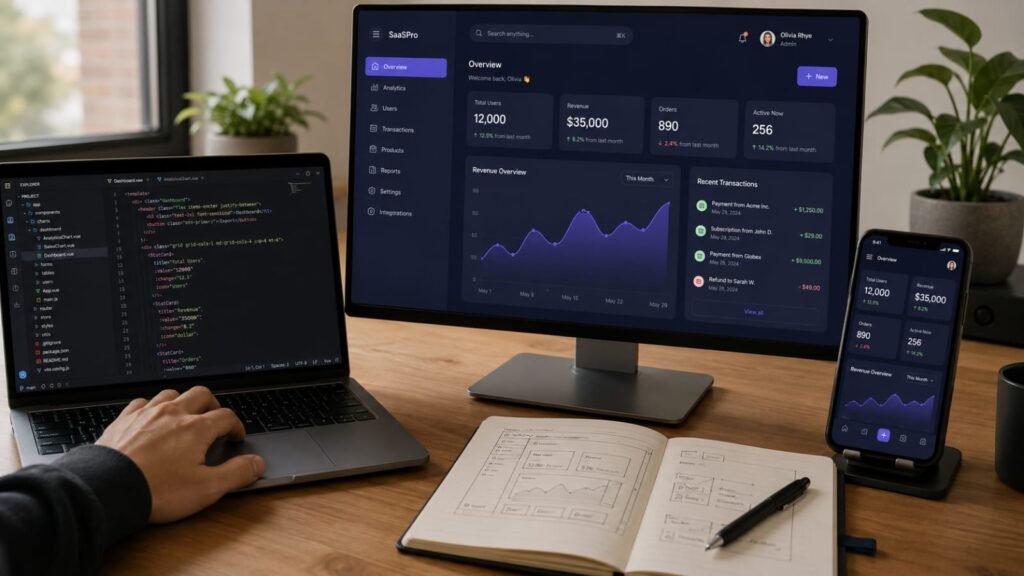
The SaaS Development Process: Step by Step
Building a SaaS product is a journey. Here is the process that professional teams follow.
Step 1: Research and Validate Your Idea
Before writing any code, confirm that people actually want what you plan to build. Talk to potential customers. Study competitors. Find out what problem you solve and why people would pay for your solution.
Many SaaS products fail not because of bad code but because nobody needed them. Validation protects your budget.
Step 2: Define Your Product Strategy
Decide who your target users are, what your main features will be, and how you will make money. Write down your goals and the key numbers you will track, such as monthly recurring revenue, churn rate, and customer acquisition cost.
Step 3: Plan Your Minimum Viable Product
A minimum viable product, or MVP, is the simplest version of your software that still solves the core problem. It includes only the must-have features.
Building an MVP lets you launch faster, spend less, and learn from real users. You can add more features later based on feedback.
Step 4: Design the User Experience
Good design makes software easy to use. Designers create wireframes and clickable prototypes that show how the product will look and flow. Test these with real people before development begins. Fixing a design problem on paper is far cheaper than fixing it in code.
Step 5: Choose Your Technology Stack
Select the programming languages, frameworks, databases, and cloud tools your product will use. Pick technologies that fit your needs, have strong community support, and are easy to hire for.
Step 6: Build the Product
Development usually happens in short cycles called sprints, often two weeks long. At the end of each sprint, the team delivers working features that can be reviewed. This agile approach keeps the project flexible and transparent.
Developers work on three main areas:
- Front end: what users see and click
- Back end: the logic, database, and servers behind the scenes
- Integrations: payments, email, analytics, and third-party tools
Step 7: Test Everything
Quality assurance is critical. Testers check that features work, the product loads quickly, and the software stays safe under heavy use. Testing includes functional testing, performance testing, security testing, and user acceptance testing.
Step 8: Launch
Launching is more than pressing a button. You need to prepare your servers, set up monitoring, train your support team, and plan your marketing. Many companies start with a small beta group before opening to everyone.
Step 9: Maintain, Improve, and Scale
SaaS development never really ends. After launch, you will fix bugs, release updates, respond to customer feedback, and improve performance. The best SaaS companies treat the product as a living thing that keeps getting better.
Choosing the Right Technology Stack
Your technology stack is the set of tools used to build your product. There is no single perfect stack, but here are common options.
Front end: React, Angular, and Vue.js are popular choices for building fast, interactive interfaces.
Back end: Node.js, Python with Django, Ruby on Rails, Java with Spring, and .NET are all widely used for SaaS products.
Databases: PostgreSQL and MySQL work well for structured data. MongoDB suits flexible data. Redis helps with speed and caching.
Cloud and DevOps: Docker and Kubernetes help package and run applications. CI/CD pipelines automate testing and deployment, so updates reach users quickly and safely.
Security and Compliance for SaaS in the USA
Customers trust SaaS companies with sensitive information. A single data breach can destroy that trust and cause serious legal and financial damage. Security must be built in from day one.
Key Security Practices
- Encrypt data when it is stored and when it moves across the internet
- Use strong authentication and permission controls
- Run regular security audits and penetration tests
- Back up data often and test your recovery plan
- Monitor systems around the clock for unusual activity
- Keep all software and libraries up to date
Compliance Standards
Depending on your industry, you may need to follow specific rules:
- SOC 2: a common standard that proves your company protects customer data. Many US business buyers ask for it.
- HIPAA: required for software that handles protected health information.
- PCI DSS: needed when you process credit card payments.
- CCPA: California’s privacy law, which affects any business serving California residents.
- GDPR: relevant if you also serve users in Europe.
Planning for compliance early is much easier than adding it later.
SaaS Pricing Models
How you charge customers affects your growth, so choose carefully. Here are the most common models.
Flat-rate pricing: One price for one product with all features. Simple, but not flexible.
Tiered pricing: Several plans, such as Basic, Pro, and Enterprise, each with more features or limits. This is the most popular approach.
Per-user pricing: Customers pay for each person who uses the software. Easy to understand and scales with the customer’s team.
Usage-based pricing: Customers pay for what they use, such as data stored or actions completed. This feels fair, though revenue can be harder to predict.
Freemium: A free basic plan with paid upgrades. It attracts many users, but you need a clear reason for people to upgrade.
Test your pricing and adjust it over time. Pricing is one of the most powerful growth levers you have.
How Much Does SaaS Development Cost?
The honest answer is that it depends. Cost is shaped by the size of the product, the features, the design, the team, and the timeline. Here are rough ranges for the US market:
- Simple MVP: $30,000 to $80,000
- Mid-level product with several features: $80,000 to $200,000
- Complex, enterprise-grade platform: $200,000 to $500,000 or more
What Affects the Price?
- Number and complexity of features
- Quality of UI and UX design
- Third-party integrations
- Security and compliance needs
- Team location and experience
- Ongoing hosting, support, and maintenance
Remember that launch is not the finish line. Plan to spend around 15 to 25 percent of your original development cost each year on maintenance, hosting, and updates.
Ways to Control Costs
Start with an MVP. Focus on features that matter most. Use proven tools and cloud services instead of building everything yourself. Work with an experienced team that can avoid expensive mistakes.
Common SaaS Development Mistakes to Avoid
Even smart teams make errors. Here are the most common ones and how to prevent them.
Building too much too soon. Adding every possible feature before launch wastes money and delays feedback. Keep version one focused.
Ignoring user feedback. Your users will tell you what they need. Listen to them early and often.
Skipping security planning. Fixing security later costs far more than building it in from the start.
Poor scalability planning. A product that works for 100 users may crash at 10,000. Design for growth.
Weak onboarding. If new users do not understand your product quickly, they leave. Create simple guides, tooltips, and welcome flows.
Not tracking metrics. Without data, you are guessing. Track activation, retention, churn, and revenue from day one.
Choosing the cheapest developer. Low prices often mean poor quality, which leads to rebuilds and higher costs in the long run.
How to Choose a SaaS Development Company
Picking the right partner is one of the biggest decisions you will make. Look for these qualities.
Proven SaaS experience. Ask to see products they have built and results they have delivered. A team that understands subscriptions, multi-tenancy, and billing will move faster and make fewer mistakes.
Clear communication. You should know what is happening at every stage. Regular updates, demos, and open conversations matter.
Strong technical skills. The team should be comfortable with modern frameworks, cloud platforms, and security practices.
A structured process. Look for a team that uses agile methods and shares clear timelines and deliverables.
Post-launch support. Your product will need updates and fixes. Choose a partner who stays with you after launch.
Transparent pricing. A trustworthy company explains what you are paying for and why.
Before you sign anything, ask about code ownership. You should own the code and the intellectual property of your product.
Trends Shaping the Future of SaaS Development
SaaS keeps changing. Here are the trends that matter most right now.
Artificial intelligence. AI features such as smart search, chat assistants, automated reports, and predictive insights are becoming standard in many SaaS products. Adding useful AI can make your product stand out.
Vertical SaaS. Instead of serving everyone, many new products focus on one industry, such as healthcare, construction, legal services, or real estate. Specialized tools often win loyal customers.
Low-code and no-code tools. These speed up development for simple features and internal tools, though complex products still need custom engineering.
Product-led growth. More companies let users try the product first, through free trials or free plans, and rely on the product itself to drive sales.
Stronger focus on privacy. Users and regulators expect better data protection, so privacy-first design is a real advantage.
Embedded finance and integrations. SaaS platforms increasingly include payments, lending, and other financial features directly inside the product.
Staying aware of these trends helps you build a product that stays useful for years.
Why Work With Isnova Tech for SaaS Development
Building a SaaS product takes strategy, skill, and patience. Isnova Tech helps businesses and founders turn ideas into reliable cloud software. The team focuses on practical, scalable solutions that fit real business goals.
Here is what a good SaaS development partner like Isnova Tech brings to your project:
- Idea to launch support: from early planning and design through development, testing, and deployment
- Scalable architecture: software built to grow as your customer base grows
- Secure development: strong protection for your data and your customers’ data
- Clean, modern design: interfaces that are simple and enjoyable to use
- Ongoing support: continued improvements and maintenance after your product goes live
Whether you are a startup building your first MVP or an established company moving to the cloud, the right development partner can save you time, money, and stress.
Frequently Asked Questions About SaaS Development
How long does it take to build a SaaS product?
A simple MVP usually takes three to six months. A larger, more complex platform can take nine months to a year or longer. Timelines depend on features, team size, and how quickly decisions are made.
What is the difference between SaaS and custom software?
Custom software is built for one specific company. SaaS is built to serve many customers through a subscription. Some companies build custom software first and later turn it into a SaaS product.
Do I need a technical co-founder to build a SaaS product?
Not always. Many non-technical founders partner with a trusted development company. The key is to find a team that communicates clearly and understands your business goals.
Is SaaS development profitable?
It can be very profitable. Recurring revenue, high margins, and easy scaling make SaaS attractive. However, success depends on solving a real problem, keeping customers happy, and controlling costs.
What is the best programming language for SaaS?
There is no single best option. Python, JavaScript with Node.js, Ruby, Java, and .NET are all strong choices. The right pick depends on your product, your team, and your long-term plans.
How do I get my first SaaS customers?
Start by talking to people who have the problem you solve. Offer early access or a free trial, collect feedback, and improve. Content, partnerships, and referrals also help early growth.
Can I add AI to my SaaS product?
Yes. Many products now include AI for tasks like automation, recommendations, and content generation. Start with a clear use case that saves users time or improves results.
Final Thoughts
SaaS development is one of the smartest ways to build a modern software business. It offers recurring revenue, global reach, and the freedom to improve your product continuously. But it also demands careful planning, strong engineering, and a deep focus on your customers.
Start by validating your idea. Build a focused MVP. Design for security and scale from day one. Listen to your users, track your numbers, and keep improving. If you follow these steps, you will be on a strong path to building a SaaS product that people love and pay for.
If you are ready to start your journey, choose a development partner who understands both technology and business. With the right team, your idea can become a successful SaaS product in the US market and beyond.